Omnibus vs Custom Surveys: Which Is Right for Your Campaign
Compare omnibus and custom research by audience, questionnaire needs, planned comparisons and deliverables before choosing a format.
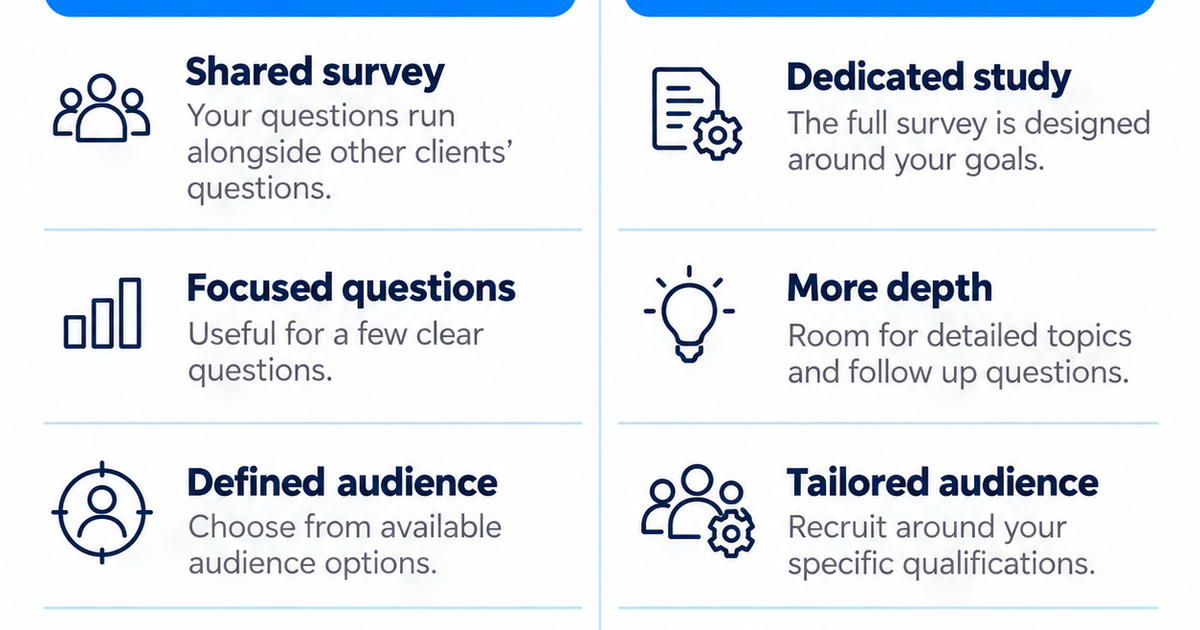
An omnibus survey can work well when you need a focused set of consumer questions answered quickly. A custom survey is often more appropriate when the campaign requires a specialised audience, a longer questionnaire or detailed comparisons.
Both can produce useful findings. The choice depends on the question you need answered and how you plan to use the results.
I would start with those decisions before choosing the format. Otherwise, it is easy to buy a convenient research option and discover that it cannot quite support the story your team wants to explore.
What an omnibus survey includes
An omnibus allows several organisations to place their own questions within a shared survey. The sponsors share underlying fieldwork costs, while receiving the findings associated with their own questions.
Think of a consumer brand that wants to understand attitudes toward holiday spending. If the target is a broad consumer audience and the question set is focused, an omnibus may be a practical fit.
The important details still need review. Who participates? Which demographic controls are used? When will questions enter fieldwork? What tables and methodology language will you receive?
CITE's omnibus survey service explains how focused questions can move through scheduled waves. Confirm timing and audience suitability for your specific project before planning a release around the results.
What a custom survey changes
A custom study gives you more control over the research experience. You can define specialist qualifications, develop related questions and plan an analysis around the campaign's needs.
For example, a cybersecurity company might want to examine how security leaders evaluate AI products, what slows approval and how priorities differ by company size. That could require a dedicated questionnaire and carefully qualified participants.
Custom research also offers room to explore a topic from several angles. It can support a report with more depth, provided the questionnaire remains focused and the participants can answer it reliably.
Our PR survey research approach includes both options. We recommend the design after discussing the audience, objective and intended uses.
Start with the audience rather than the deadline
Speed is useful only if the right people answer the questions. A survey of adults generally cannot establish what security executives think about procurement. A survey of employees cannot automatically describe company policy.
Before discussing formats, define whose experience matters. Then ask whether those people can be reached through the proposed approach and whether enough will qualify for the comparisons you need.
CITE's audience recruitment capabilities can help frame that discussion. The qualification requirements may determine the format more clearly than the number of questions does.
Check the depth of the question set
If your campaign needs a few straightforward measures, an omnibus may be enough. If answering one question requires several follow-ups, complex routing or detailed background, discuss a custom design.
Be careful about squeezing a complicated idea into one question to save space. Asking respondents about price, performance and support together may produce an answer you cannot interpret.
The better approach may be to narrow the objective or give the topic the space it needs. Your research partner should explain which option preserves the usefulness of the results.
Compare the complete deliverables
Ask what each option includes beyond interviews. Questionnaire review, data checks, crosstabs, methodology documentation and interpretation all affect what your team can do with the findings.
Also discuss subgroup results. A broad consumer sample might include relatively few people with a particular experience. If that group is central to the story, the total number interviewed may be less useful than it first appears.
Confirm ownership and permitted uses in the proposal. Sharing fieldwork does not mean sharing your findings with other sponsors, and the agreement should make the arrangement clear.
Bring the campaign question to the first conversation
Tell your research partner whom you need to understand, which comparisons matter, when you need results and where the findings will appear.
An omnibus can be a sensible choice for focused consumer research. A custom study can provide the flexibility a more specialised campaign needs. Neither should be selected solely because it sounds faster or more comprehensive.
If you are weighing the options, discuss your campaign with CITE Research. We can help you choose an approach that fits the question and the people qualified to answer it.
Written by
Andrew Edwards
Andrew Edwards is the CEO of CITE Research, a tactical global market research firm specializing in B2B, PR, healthcare, and hard-to-reach audience research. He has led hundreds of quantitative and qualitative studies for technology, cybersecurity, financial services, and healthcare clients across North America, Europe, and Asia-Pacific. Andrew writes on research methodology, data quality, and the strategic use of original research in B2B marketing and communications.